Tuesday, 29 December 2015

Why 'Court' (2015) deserves its National Award

Every year there is a wave of independent films that make a splash in critics’ circuits and at international film festivals, but only a few manage to make it to a commercial release. It is a formidable achievement on the part of the makers and the financiers of the film to bring it to the people it is based on.
As the multiple-award winning film Court completes one year since its premiere at the Venice Film Festival, it is time to look back on what won it the highest Indian honour for feature films – Best Feature Film at the National Awards.
Narayan Kamble, a lokashaheer (activist poet and folk singer), is charged with the abetment of the suicide of a sewer worker. This alleged abetment comprises of ‘inflammatory’ songs that Kamble sings about the deplorable condition of sewer workers, amongst other social issues.
The trial forms a major part of the film, and this columnist believes it succeeds in bringing to the screen the ground realities of the lower courts. However, after a few scenes into the movie we realise that the courtroom setting is a gateway to other important questions raised by the film.
What makes this film more than merely a realistic portrayal of the Indian judicial system is the humanity it imbues its characters with – each important character, including the seemingly infallible judge, is subject to deep-seated prejudices.
On one hand, the film exposes inefficiencies behind drawn-out court cases and an interpretation of the law which is true to the letter but not to the spirit. On the other, it unravels and explores the motivations, hopes, and fears of the people, and the tedium of their daily jobs. The film is equally interested in both what happens outside the courtroom and what happens within it.
The three main characters the film chooses to focus on are Kamble’s defence lawyer, the public prosecutor, and the presiding judge. While the court-scenes are top-notch, there are also thoughtful scenes where the film delves into the characters’ personal lives, often painting a picture counter-intuitive picture to the impression they make in their workplace.
The defence lawyer is seen enjoying an active nightlife, shopping for alcohol, and paying frequent visits to the salon – things which hint at his privileged background, but could be considered improper for a socially aware lawyer who provides legal help to the disadvantaged and engages in legal activism. His tough and powerful arguments, ridiculing various absurdities – such as antiquated laws dating to the 19th century – are deftly presented alongside a scene in which he breaks down, sobbing with his back to the camera. One wonders whether this points to the notion of sentimentality’s apparent incompatibility with masculinity.
The director’s keen lens is similarly cast on the gender divide in society through a seemingly harmless yet extremely insightful scene which shows men and women from the same family sitting apart and talking about two different sets of topics.

One can see the tedious monotony that has crept into her daily life when we see the public prosecutor go about her daily chores, or chat nonchalantly with her colleagues about handing out a prison sentence to Kamble and being done with the case.
The film subtly covers a range of issues in its two-hour runtime. These issues aren’t deliberately inserted in the narrative to score extra brownie points or to flaunt the label of social consciousness. They are an organic part of the narrative and help the viewer understand the characters’ motivations.
The social and economic backgrounds of the characters are expertly contrasted with one another, especially those of the two lawyers. Caste divides are silently commented upon as well – the testimony of thedeceased sewer worker’s wife shows how many people from backward castes have to undertake dangerous work just to feed their families. One also sees how linguistic backgrounds are both connecting factors and barriers. The public prosecutor shares a language (Marathi) with the judge, which perhaps gives her leeway with her lax arguments. Kamble’s lawyer, on the other hand, possibly because of his crisp English and ignorance of Marathi, has to work harder to find his feet, make himself understood and follow the interrogation of witnesses.
The greatest strength of the film, which is a credit to Tamhane’s observational acumen, is the subtle humour that underlines it throughout. Small but important details include lawyers hunting for clients outside the court, like roadside sellers who sell their wares to passers-by; the sessions-court judge peppering her dictation of court proceedings with casual instructions to her typist to exclude superfluous sentences; or the men who inadvertently interrupt a lecture by bringing in a fan and fumble around to find a place for it.
These seemingly insignificant details not only lend credibility to the film but also allow the viewer to maintain a position of relative objectivity, like a CCTV camera on a wall. This is helped by lengthy takes, where the camera stays still for a long period of time or follows the characters around instead of cutting to another angle, establishing the setting before the characters enter the frame, and the rolling of the camera long after a scene has ended.
For years, courts have been depicted as hallowed halls in which lawyers sermonise and deliver eloquent speeches, spectators break into sporadic applause like audiences at political rallies, and judges listen mutely to powerful pleas of justice. Court is a film which gives us a more convincing picture of reality, and, as expected, it is a far cry from regular cinematic fare.
Intelligent, funny, and insightful, Court deserves its National Award.

(The film has been written and directed by Chaitanya Tamhane and is the filmmaker’s debut film.)
First published here: http://theindianeconomist.com/why-court-deserves-its-national-award/

Source for image: http://www.hindustantimes.com/movie-reviews/court-review-tamhane-s-film-deals-with-intolerance-and-censorship/story-e44dGAYQQ59vqhv8rjtBiI.html

Friday, 25 September 2015

Interstellar and thoughts on its climax


Every Christopher Nolan film carries with itself the unspoken tag of a complex narrative. Interstellar is no different. Some films demand a repeat viewing to catch all the intricacies of the filmmaking techniques used, like the meaning of a shot when the camera pans over to an object or a person, a seemingly innocuous glance or a smile, the use of colours in the frame, the way the camera moves in a particular scene or to uncover and trace clues leading to the climax scattered throughout a thriller. 

A lot of Nolan’s films, on the other hand, often leave your head spinning in bewilderment when it comes to understanding the plot, and for his fans, the more you have to rack your brains for a film, the better it is. Whether this is a skill or in fact a weakness of the filmmaker in conveying his vision to his audience effectively is up to the viewer to decide. His films have an influence well beyond the cinema hall; internet forums and even water cooler discussions reek of excitement as the film is vigorously decoded and theories of different interpretations built around it. 

When it comes to Interstellar, I think it is necessary to draw a distinction between the novelty of the subject matter and the filmmaking craft employed to deliver it. Nolan’s films have intriguing plots, no doubt, but how successful they are in translating it into cinematic language requires a separate evaluation. Interstellar does not impress on the storytelling front as it does on the complex thought process that has gone into it and the scientific accuracy which is so elusive in other big-budget sci-fi films (can't say the same about the end though)**. 

The feeling I got after watching Interstellar was like reading through someone’s diary, the technical jargon notwithstanding, with thoughts scattered a bit haphazardly, sometimes touched upon only to be left halfway without being fleshed out. The dialogue is expository, with much of the film needing its characters only to put the technical background and the philosophical debate across to its audience, with no narrative arc of their own.

We hear Brand speak about how emotions and the attachment to our loved ones can be a component of the equation and the answers we are seeking, or Mann elaborating on how it is our survival instinct that trumps everything else, but all these composite ideas are not stringed to form a cohesive picture. They are food for thought in isolation, but the narrative, and especially the end, instead of reconciling these ideas or presenting the conflict between them uses its characters as mere stand-ins to represent them. 

The climax is rushed, filled with technical jargon, which could have been presented in a more visual manner, in the language of cinema. Also, the final scenes do not follow organically from the rest of the film. While these may be minor issues with respect to the overall impact of the film for some, I think a good filmmaker’s films, like Nolan’s, are inevitably subjected to higher standards of critique and appreciation.

**Even the scientific accuracy of the climax might be suspect, if one goes by some reports about the film. So not only is the climax rushed, jarring with all the jargon and contrived to make the film end on a positive note, it is also unconvincing.
Source for Image: http://screenrant.com/interstellar-ending-spoilers-time-travel/

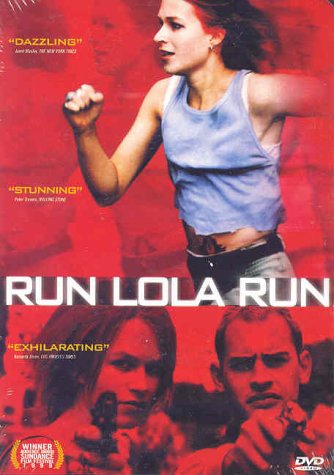
In Appreciation of the German Film 'Run Lola Run' (Lola Rennt)


Take this scene- A woman running. For 20 minutes. How will you present this scene on film and keep your audience riveted on the edge of their seats for its entire length at the same time? If I were to summarize this film in a nutshell, it would be that it consists of 3 possible scenarios of a woman rushing to help her boyfriend out in an emergency. And no, it does not turn out to be something akin to watching a lone woman sprinting on a race track.
If there is one film, among the ones I have watched so far, which makes full use of cinema as a medium, then it is this. There are many films, where if you change the medium, say make it into a play instead of a film, it would make little difference to how it looks, except perhaps for the set designer and special effects team.

Run Lola Run scores high on all the technical aspects which distinguish cinema from other mediums of art- cinematography, sound design, editing and screenplay. And all of this is done without affecting the overall impact of the film, where the vision of the filmmakers reaches the audience without making them conscious of the complex nature of its composition, or intimidating them with in-your-face technical jargon that has gone in its making. And this does not mean, of course, that it lags behind in other departments which are immediately apparent to the viewer like acting. All this makes it an excellent example of a film which cannot be understood by reading its synopsis alone, making the 'how the story is told' the most important aspect of storytelling.

The most prominent theme of the movie is the passage of time, and how one reacts in a situation where one does not have much of it at their disposal. Lola's urgency and her compelling need to reach her boyfriend in time is perfectly reflected in the film's score and production design (which offers temporal cues for how the clock is ticking away). There is a visual of a falling row of dominoes early in the film to illustrate the chain the events triggered by Lola while bolting from one street to the next that are to follow soon.

 The quick cuts and the photo montages of the people Lola bumps into on her way enhance the pace of the film even more. Almost every scene that is repeated thrice in the film is done with a few changes, which can be caught by a keen viewer, to show the different possibilities of how an inevitable event might play out.

While the film carries us on a roller-coaster ride with the heroine's antics, the filmmakers (in the plural because the director's vision is also shared by all those who have worked on other aspects of it) have also put a lot of thought into the significance of the events presented. The film is a maze of possible event scenarios just to show how easily things could have gone the other way or could have happened differently. It keeps a record of every second and shows how a slight change in the coordination of human action with time can have desirable or disastrous consequences, which makes us appreciate the chain of our day to day actions and the links between them more closely.

P.S: Special Thanks to Jnana Prabodhini Film Club for screening this very special film.

Sunday, 13 September 2015

Some thoughts on Imtiaz Ali's Highway


Quite rarely, we get to see a film which sets out with seemingly no culmination to the narrative in view. True to its title, the film is a meandering long drive we often go for with no destination in mind. It opens with a young woman named Veera being kidnapped by a contract criminal in a skirmish with a rival gang on the eve of her nuptials. 

What follows is a road movie, accompanied by scenic shots of the raw and rustic landscape, with every location showcasing the rough terrain, almost untouched by the hustle and bustle of urban settlement. The same can also be said of the two protagonists, Veera and Mahabir, who distance themselves from the humdrum of society and its expectations from them as the film progresses. It has most of the elements of its genre, along with the protagonists’ trip to self-discovery, except that it still gave me a sense of being on wheels long after the lights had turned on.
 
While some may label the relationship that Veera shares with her abductor Mahabir and her sympathy for him as Stockholm syndrome or also romantic love, the film presents us with neither. It steers clear of conventions and established tropes in relationships, something that Ali has tried to showcase in his earlier films as well. It leaves us with two leads who share an understanding that is hard to label, which is reflected in Veera’s attempt at convincing Mahabir to take her along with him. 


The two leads come from disparate backgrounds. While Veera is a member of the elite, affluent and influential section of the society, Mahabir is the birth child of the depraved in it. But the contrast ends here, as both defy the stereotypes of their background and place in the world. Both find common ground in their traumatic childhood experiences, which they have been trying to put behind them for a long time and share an unspoken bond of empathy. Both find their social circles constricting and ultimately a handicap in living full-blooded lives. 

The scene where Veera loses her shoes in the wide desert is poignant in how she lets go of her inhibitions and fear and accepts her new surroundings and the approaching days of nomadic abandon. Her travels reach a high point in the scene when she finally loses a sense of her former self and dances without a care in the world, as Mahabir looks on with hesitation into an uncertain future with the remote promise of freedom and peace. He observes her for much of the film, trying to come to terms with his desire to lead an unblemished life free from his difficult criminal past, but knowing all along that he would be doomed if he were to give action to his thoughts.
 
The film caters to and brings out the poetic sensibilities of Ali, which have also made their presence felt in his earlier work-almost to the point where the main character mouths a few couplets herself. It has a lot of spontaneous sequences which seem to not have been a part of the original script, and which form a harmonious synergy with the frames of unrefined locales explored in the film. 


Bhatt has the opportunity to emote a gamut of experiences and does not fall short of the challenge, making the monologues and her private talks to herself her own, without making them appear facile and an awkward break from the long silences. 

Hooda has very little lines and has to rely solely on his body language in providing an insight into his Mahabir which goes beyond the gruff exterior and irascible temper. While it’s clear from the start who the primary focus of the film is, Mahabir feels neglected, often being reduced to being a mere observer on the outside rather than a character with his own inner struggles who is confronted with an unprecedented situation. His character arc is sidelined as he is only an agent of bringing out the free-spirit that marks its heroine in the later parts.
 
(Spoilers)
Rehman and Ali weave the former’s score effortlessly into the narrative, enhancing the storytelling. Although the storytelling is restrained in many places, like when the audience is informed of Mahabir’s passing (which is done in a no-frills, prosaic manner), the sentiment behind the film is evident in the scenes towards the end. Slightly flawed yet earnest, it is Imtiaz Ali’s bravest and best film to date.

Some thoughts on Anurag Kashyap's Ugly

While the offbeat and art film circuit and enthusiasts have been raving about Anurag Kashyap, this was my first film with him at its helm -both as the screenwriter and director. Dark, unsettling, often upsetting, the film lived up to the expectations that Kashyap's brand of cinema usually carries with itself. At its surface, the film is about kidnapping mystery, but at its heart, it is a disconcerting, gritty tale about the underside of the one-upmanship battles of the characters against each other. As the mystery deepens, the conflicts between its characters unravel and come to the fore. The entire web of double crossing and deceit becomes so intertwined, that it becomes a circus - which is made apparent in a scene where a boy waiting tables performs a seemingly bizarre act with small bells.

Tautly edited, the film is a bit indulgent at places, especially in the scene where Rahul, the father of the girl who has been feared kidnapped and his friend cum colleague Chaitanya go to register a complaint at a police station. The scene is long drawn out, but is a tastefully written one nevertheless. What is a thrilling chase by the duo to nab a man who seems to have a hand in the kidnapping, ends in a macabre accident and is followed by this long scene with the cops, who keep asking unnecessary questions about Chaitanya's profession and cracking trivial jokes when time is running out for the lost girl. Police apathy might have been a theme behind it; however the sudden shift in tone, serves as a prologue to what is to follow in the rest of the film. The girl, who has disappeared without a trace, becomes secondary as the characters get busy in settling old scores with each other, which makes the end hard-hitting and gut-wrenching, reminding us of what the film was originally about. As would be true of any gritty film with such kitchen-sink realism, it eschews black and white characterizations and the viewer oscillates between sympathy (and aversion) from one character to the other. Ronit Roy's Shoumik Bose comes across as a menacing, corrupt cop at first only to be shown as a victim of ragging in college later.

One can visualize Kashyap smirking, when the film takes a subtle dig at mainstream commercial bollywood and it's item numbers in a rib-tickling scene between Shoumik and a subordinate cop (Jadhav) investigating the case. It also touches briefly upon the child trafficking industry, when Jadhav comments that fair-skinned girls find a better price in the market and when a few other girls are rescued in the investigation, but does not delve further into it. One can quite understand why this is so- when there is so much filth in what should be normal interactions and relationships, who needs to go into the criminal world? The performances are brilliant with Vineet Singh and Girish Kulkarni delivering nuanced acts. Highly recommended, but is best skipped if one is looking for a light-hearted entertainer for the New Year's.

Some Thoughts on Amores Perros

"Masters take after their dogs, you know", says one of the protagonists, El Chivo, to his abductee, whom he’s been hired to kill. Muttered unwittingly in amusement, the line stands true for the entire film, which is an anthology of three distinct stories, its characters lives’ strangely intertwined through a road accident.  Being from disparate backgrounds (economic inequality is major running theme of this multiple award-winning film), the 3 protagonists have very little in common except the attachment to their dogs, who seem to share an uncannily similar fate as their respective masters. The conflicts in their lives are expertly portrayed through these dogs.

This film is the perfect example of the "show, don’t tell" film-making principle, for there is hardly any unnecessary exposition about the characters and the situations they find themselves in.  Right from the early scenes, Octavio, the young protagonist of the first story, betrays a palpable affection for his sister-in-law Susana, with whom he has been in love for a long time, before we see him declare his plans of eloping with her. A glamorous poster of a model in the second story perfectly represents her career aspirations and a life sunk in oblivion after she loses her leg in the accident. El Chivo’s longing to meet his daughter, who thinks her father is dead, is shown through the photo album he frequently flips through. The editing is superb as the sudden cuts and the blink-and-you-miss scenes help in establishing the hard-hitting realism of the movie. The next two stories make short appearances in the first, before being fleshed out separately as the plot unravels.

 Dreaming of settling down with Susanna, Octavio enrolls his tenacious dog in an underground canine fight club to earn a quick buck. Within no time, the dog climbs the ladder of the dog-fighting scene to emerge a beast with a fierce reputation for the number of dogs he has either killed or injured.  At the same time, Octavio shares the violence of his dog’s life in his own life, when he has his brother beaten up, and when he stabs a rival dog owner who shoots his dog. His aggression is in a way reactionary, similar to his canine friend, who gets in his first fight after being intimidated by a seasoned dog on the street.

The second story starts with the fashion model, Valeria, moving in with her lover Daniel, who has left his wife and daughters for her. After getting hit by Octavio’s car, she severely injures her leg. Unable to rescue her injured dog, who falls through a crevice in the floor, she begins blaming Daniel for not doing enough to get him out and doubts his love for her. Confined to her wheel-chair, her situation is not very different from her trapped dog as her anxiety for it and her own recovery is mirrored in its whines emanating from below the wooden floor. Her dream to return to her once successful modelling career bites the dust, when she loses her injured leg and watches an empty billboard from her window that had her glamorous poster earlier, looking over the city. By the time Daniel finally manages to get the dog out, it is too late and the holes in the floor are a grave reminder of the fissures in Valeria’s and Daniel’s relationship, who seems to ponder over his now waning love for the wheel-chair bound Valeria.

The accident which sees Valeria injuring her leg, also sees El Chivo, the third protagonist, who is a vagrant rag picker and a hit-man, find and heal the wounded dog of Octavio. He confronts his choice of profession, when the dog kills all of El Chivo’s other dogs, who seem to be his only companions in his rundown house. Shaken by the realization of the rot in his life reflected in the squalor of his surroundings through the murders he has committed, he spares the life of the above mentioned abductee. He then leaves the city after leaving an emotional explanation of the reason for his abandonment of his family on his daughter's answering machine.

Infidelity is a theme common to all three stories, but is handled in different ways throughout the narratives. Susanna, who has the chance to escape her abusive husband, and who shows all the tell-tale signs of a domestic violence victim, yields to the abuse and decides against abandoning him. This could be possibly because of her submission to abuse as a child, owing to her mother’s alcoholism, which is subtly hinted in the film. In contrast to this, Daniel, who has cheated on his wife, seems to silently regret his actions. The third story, where El Chivo’s wife marries his brother after the former’s incarceration, has some resemblance to Susanna and Octavio’s relationship, except for the fact that EL Chivo understands and accepts his estranged wife’s actions, while struggling to establish his right over his daughter. The scene,where he morphs from his unkempt appearance into a clean shaven and neat avatar, sporting a suit,is a poignant pointer to his earlier life of an affluent man, whose appearance is a far cry from the bedraggled rag-picker. Yet, both are the same person, serving as a reminder of how the affluent, driving away behind the tinted glasses of their cars and past the destitute walking down the street, are not so different from them and how difficult it is for people who have lost face in society to re-assimilate themselves back into the sphere of their former life.

P.S: I am glad to have watched this film on the big screen, courtesy the Jnana Probhodini Film Club. 

Some thoughts on Vishal Bhardwaj's Haider (Spoilers)

Being the third and the last film, in a series of adaptations of the famous plays of Shakespeare, Vishal Bhardwaj has become quite good in transforming the iconic English verses and soliloquies of the master dramatist to their poetic equivalents in Indian languages and setting the frequently adapted characters in a distinctive Indian milieu, making them his own in the process. All of the adaptations have a common theme running through them-tragedy. As seen in his previous body of work, Bhardwaj’s penchant for dark humour is quite evident in this film as well. It’s most obvious when Hamlet’s Rosencrantz and Guildenstern make an appearance as two video parlour owners, who fool around mimicking Salman Khan and hum and groove to songs from his movies, when not recommending his videos to their customers. In any other mainstream Hindi film,these two ‘Salmans’ (their names in the film) would have been the obligatory comic relief, divorced from the mood of the rest of the film. But here, when these ‘adorable’ and seemingly harmless buffoons are shown as the uncle’s henchmen tasked with killing Hamlet, it suddenly throws them into dangerous light, much like the offhand executions of Kahaani’s hit-man Bob Biswas.


What Haider succeeds in (or does not, according to others) is changing the political landscape of Denmark into insurgency stricken Kashmir.Tabu’s Ghazala emerges as a symbol for the beautiful region dressed in constant political turmoil and violence. She’s a much stronger Gertrude here, with more agency of her own, but is ultimately caught between the loyalties to her lover-turned husband and her own son, the end witnessing her sacrificing herself in a bid to end the mindless bloodshed and reconcile the warring uncle-nephew duo. The end is major departure from the original play- and one does not have to think too hard to see why- where Haider chooses to abandon his plans of revenge, that has driven him till now, almost to the point of manic resolve. The film presents an unpopular and hitherto unseen perspective through its protagonist. It even goes out of its way to show alleged brutalities committed by the Indian armed forces when the narrative does not really need them, but the ultimate stand of the filmmakers is that of peace, when no such stand was necessary to make the film a piece of art. It has all the ingredients for driving home the point of futility of violence -right from an innocent Arshia, Haider’s romantic interest, getting killed in the carnage, grave diggers picking up guns in an age when it’s time for them to perhaps renounce everything, Haider contemplating how all are equal in death to the repeated use of ‘vengeance only leads to more vengeance’ that underlines the film.


The first twenty minutes of the film has a very beautifully crafted scene in it-with Khurram trying to woo and enliven the solemn Ghazala’s mood by beating the Tumbaknari, a traditional Kashmiri drum behind a big white veil, as Haider looks on with dismay-the first indication of a relationship that bloomed behind closed doors and is now slowly coming out in the open. While opinion may be divided in the authenticity of the film’s portrayal of the separatist conflict in Kashmir, I hope not many will disagree on its cinematic strengths.


P.S: The screenplay is based on Basharat Peer’s book ‘Curfewed Night’, that recounts the author’s own experiences in Kashmir, who also co-wrote the film along with Bhardwaj. And it retains Sigmund Freud's psychoanalysis of Hamlet's equivocalness as a character, which stems from his Oedipus complex towards his mother.

Some thoughts on Finding Fanny

Quirky and whimsical, Finding Fanny is definitely not mainstream Bollywood. Homi Adjania might have a nod of approval from Wes Anderson, with the latter’s peculiar and distinctive style of humour and quirk quotient characterizing the film, but will certainly make a lot of people review their tastes in films. The film has a languorous tone, and is in no hurry to unravel its minimal plot, much like the lackadaisical mood of the place where it opens, or the laid-back life of its inhabitants. Naseeruddin Shah,Pankaj Kapoor and Dimple Kapadia have meaty roles and they make the most of it, with their individual eccentricities having seemingly invisible layers underneath them.
 
For instance, Dimple Kapadia’s voluptuous figure not only gives food to the artist’s imagination and paint to his canvas but also symbolises how she conceals her fragile ego and a bitter truth about her personal life with an officious air and confident exterior. The lovelorn postmaster, whose own personal letter never gets delivered, is a figure of irony, accentuated by the climax of the film, where a man clinging on to the memories of a long lost love, and painting fantasies of a happy reunion discovers how reality has something very different in store for him. 

The film has its funny moments, two of them dealing with freak accidents resulting in death, which makes you question whether they were actually meant to be funny in the first place. It is moments such as these which touch upon another theme of the film, about life throwing surprises at you and foiling the best laid plans with its own unexpected whims and fancies.  But ultimately, in spite of all the elements that work for the film, I walked out with a feeling of dissatisfaction.It not only ties all the loose ends together at the end, but ties them in such a way that it also strikes a discordant note with the director’s vision for the rest of the film. It does not work for me as a sum of its parts, for it does not come across to me as cohesive vehicle for all its scenes and moments that set it apart.