It is
not so common for a well made film to get both an enthusiastic popular response
and critical acclaim. Newton seems to have achieved this with relative ease,
while bagging the title of being India's official entry to the Oscars
along the way. It is a dark comedy that traces the efforts of an honest
and idealistic government officer called Newton, to conduct fair elections in
the jungles of tribal and Naxal-affected Chattisgarh. Sure, there are many dark
comedies, but not many can generate humor and evoke a deep sense of
unease at the same time when security personnel are advising a
man looking to make a quick buck to surrender as a Naxalite. Newton
is one such film.

For an area which is in
the middle of a physical conflict, as well as an ideological one, Newton is the
outsider who thinks nothing of either side. His neutrality and lack of
preconceived notions about the Naxals could be a reflection of the writing-an
outsider's perspective on the issue, but combined with his unwavering faith in
democratic ideals, he becomes the perfect protagonist to take the audience on a
trip of self-examination of what it means to live in a democracy like India. As
Newton uncovers the issues facing the people of the region, so does the
audience, but it takes some reflection to see this as a film which touches upon
the myriad complexities of an issue, that is often painted with hues of
unquestioning nationalism, with biting black humour.
Newton is accompanied
by a troupe of people and CRPF forces on this task. Among them is a seasoned
CRPF officer named Aatma Singh, who tries to dissuade him from going into the
forest, a local school teacher named Malko, who is not new to the farce that is
carried out under the name of elections in such places and two clerks, one of
whom is a diabetic who writes zombie stories in his pastime. In one scene, he
narrates that the very forest they are in is also where Laxman chopped of
Shoorpankha's nose in the Ramayan. But little does he know that her tale rings
very close home to the tribals who are shown their place in a similar manner by
the state.
Singh, who in this
troupe is the state's handman and sent to do its often dirty work, has a more
realistic view of how things work in such areas, and thinks that the election
in the forest are a fool's errand. As someone whose job it is to keep the locals
under control and always be suspicious of them, he is never shown entering the
polling room (He is also forbidden to do so)-albeit in one scene where talks to
Newton more as a friend than as a leader of a security force. Tied to his duty
and his job, he is shown to be merely a cog in the wheel of the powers that be.
*Spoilers Ahead*
As it turns out, one
never sees the Naxals themselves. In fact, what is promised to be one of the
most dangerous places to conduct an election, turns out to be a forest like any
other. When we are introduced to the film's main setting in the forest, it
is deemed extremely unsafe by the authorities. Though the tone of the film is
light, such is the build-up of the dangerous reputation of this area that the
officer who is appointed to preside over the election booth shies away from the
risky task. This raises the
viewer’s anticipation of some sudden violence by the Naxals, maybe an abduction
at the very least. But the only Naxalite presence in the film is their angry
writing on the walls of the polling room. Indeed, the sole tension of the film
comes from the CRPF, who have to manufacture some conflict at the end to give
some outcome to the suspense that has been built up. Upon discovering
this, Newton tries to flee the security forces, but he is caught after a chase.
As Newton struggles and eventually gives in, the weight of the hands that pin him to the
ground might as well be the weight of the system trying to keep him in his
place. Such a treatment is fitting for a film, which appears to extol the
power of Indian democracy, but slowly peels it of its sheen instead, and lays
bare the lies and the rot within.
On its surface, Newton
appears to be about an honest government officer's efforts to conduct a fair
election in Naxalite Chattisgarh, but a lot more is going on underneath. A
stray dialogue here, a seemingly irrelevant shot there reveal all that the film
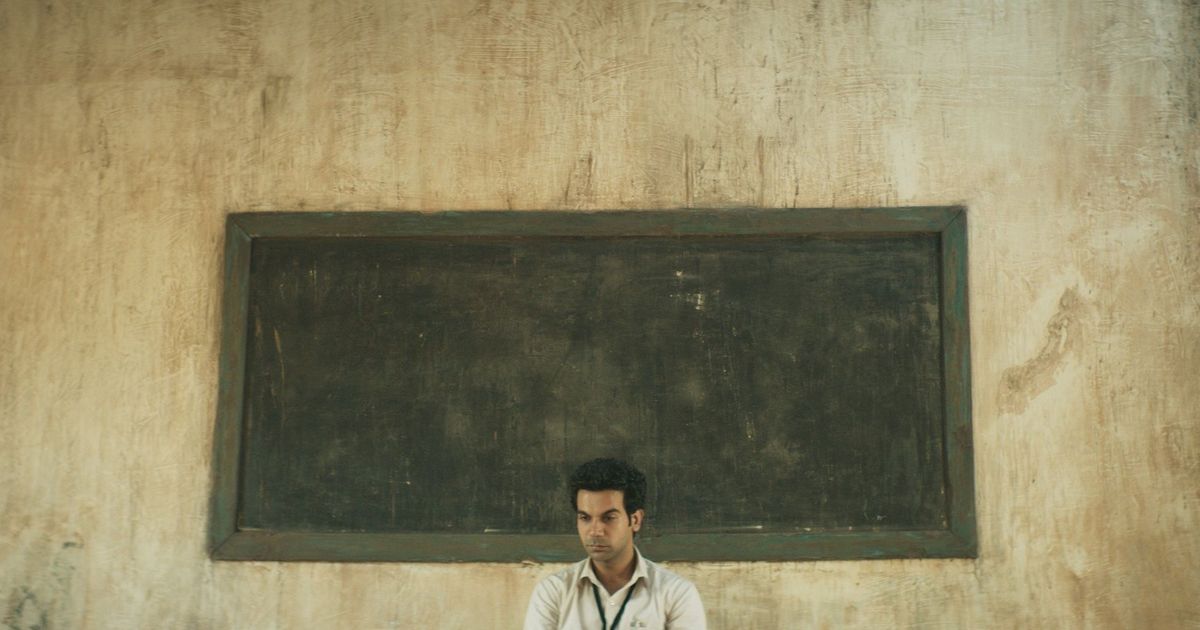
is truly about. The dilapidated school surrounded by houses razed to the
ground, which is transformed into a makeshift voting booth, could have been the
beacon of democracy’s triumph over insurgency and instability. But it is
instead the symbol of coercion, where houses are burnt by those meant to
protect, kids are interrogated and villagers are forced to vote for a system
that neither represents them nor acknowledges their language, dignity and
lives.
When the first vote is
cast after the Director Inspector General and foreign media enter the picture,
it becomes obvious that this is no longer a question of fair elections, but
that of preserving the honour of a meticulously cultivated identity. In a
telling scene, Newton tries to tell the DIG about the problems he is facing in
ensuring fair voting. The DIG asks him if there has been a booth capture or
tampering of the voting machines, and in what he says is captured the entirety
of the Indian imagination of what could go wrong in a democratic election, an imagination
which never goes on to examine some of its very fundamental flaws.
Source for the poster: By Drishyamfilmsindia - Own work, CC BY-SA 4.0, https://commons.wikimedia.org/w/index.php?curid=57713399

No comments:
Post a Comment